Upgrading Odoo
Unravelling a confusing subject
Odoo isn't just software; it's the heartbeat of your business. Because it holds your most critical data - from every sale to every stock movement -upgrading carefully and with consideration is really important.
Why is it not just Click-to-Upgrade? Why does it take so long?
It is natural to wonder why an Odoo upgrade feels different from updating an app like Adobe Reader.
When you update a PDF reader, you are simply replacing the tool you use to view files. Your actual files remain untouched and unchanged.
An Odoo upgrade is different. We aren't just replacing the "tool"; we are migrating your entire businesses digital history into a new environment.
- The Data & Workflow Translation: Odoo releases major improvements every year. Often, the way data is stored changes - sometimes fundamentally. We have to take your existing data and carefully "translate" it so the new version understands it perfectly. In some cases even workflows change, which necessitate retraining on your part.
- Preserving Your Uniqueness: If you have customised Odoo to fit your specific workflows (using Studio or custom code), those personal touches need to be adjusted and in some cases re-crafted to work harmoniously with the new features.
It's less like painting a room, and more like moving your entire family into a bigger, better house - we need to make sure all your furniture fits and nothing gets lost in the move.
Our Process: A Safe, Step-by-Step Journey
Because it's really important, we classify and handle upgrades as standalone projects, not tickets.
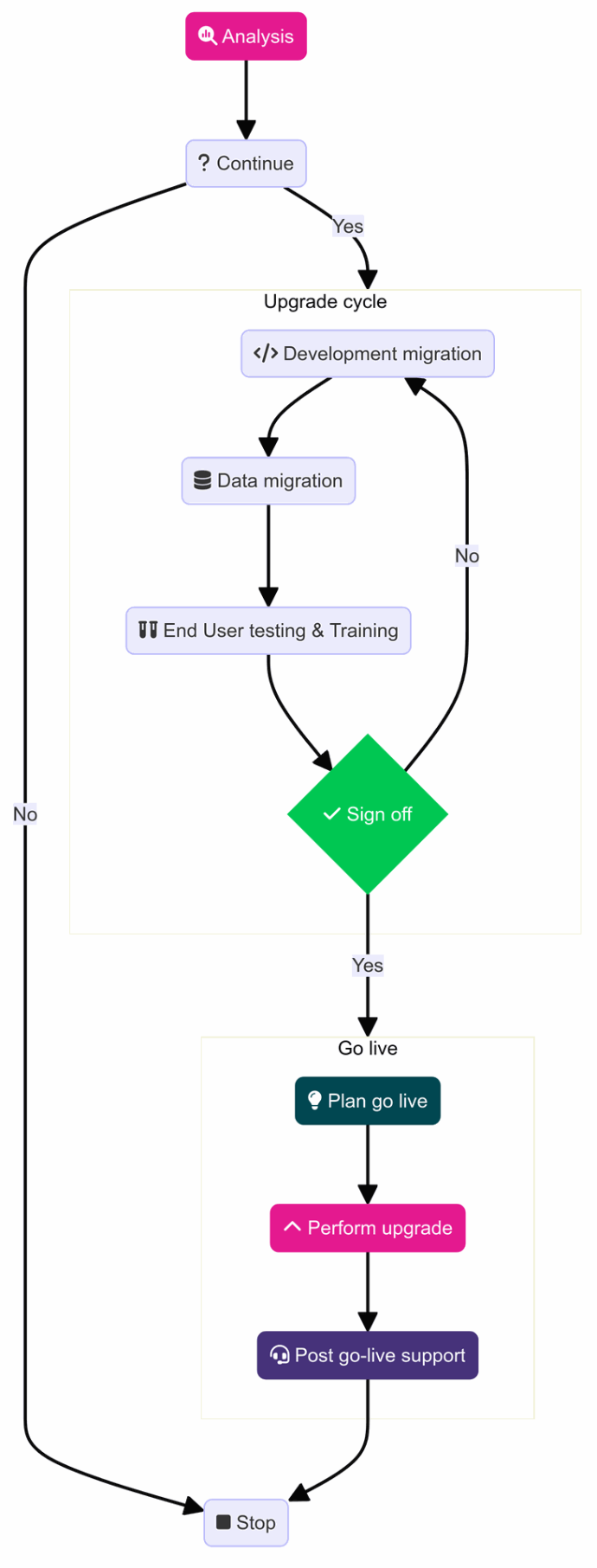
- The Deep Dive (Analysis): Before we touch a thing, we look before we leap. We analyse your current system to understand exactly how you use Odoo. We look at your customisations, your workflows, and your apps to give you an honest, clear estimate of the work ahead.
- The Work (The Upgrade Cycle): We never experiment on your live business. We create a safe, separate copies of your system to perform the work:
- Code Refinement: We update your custom features to ensure they are compatible with the fresh, new version of Odoo.
- The Migration: We work with Odoo’s official service to convert your standard data. For large databases, this calculation alone can take many hours.
- Testing: We run automated tests to catch any hiccups early.
- Your Turn (Validation & Training): Once we have a working upgraded test system, we hand the keys to you. This is your chance to explore the new features, train your team, and verify that your day-to-day operations run smoothly. We don't move forward until you are happy.
- The Big Day (Go Live): When everyone is confident, we pick a quiet time (avoiding your busy periods) to flip the switch. We take one final backup, perform the pre-rehearsed upgrade on your live system, and support you through the morning after. Plan for 1-3 days of mild disruption, out of an abundance of caution. In a utopian world everyone should know how to perform their daily tasks in the new version. Realistically this doesn't always happen, or things fall through the cracks.
We are here to help you grow. Upgrading is a process, but it unlocks powerful new tools to enhance your business. We are ready to walk this path with you, ensuring your technology keeps pace with your ambition.
Our Process: In Detail
There are 2 methods to upgrade an Odoo database. For the purposes of this article are we only considering upgrades for Odoo Enterprise. If you are interested in upgrading a database for Community, the methodology is slightly different.
The Deep Dive (Analysis)
Before we do anything we establish what state your current database is in, so we can ultimately answer the questions:
- How close to standard is this database?
- How many Studio modifications does it have? How significant are they?
- How
much custom code does it have? Does this custom code touch any areas of
Odoo we know have had significant changes? Are there enough tests for
us to know if we've broken something?
- Are there apps that were
purchased from the App Store which need newer versions purchasing? If
they're not available, what would the plan be for migration?
- Are there complex configurations that may not be catered for by the new version?
- How many Studio modifications does it have? How significant are they?
- Do we understand all your workflows? Has the customer made changes that we are not aware of?
- What customisations, if any, can or should be migrated to now standard functionality?
We provide a ballpark time estimate based on what we've found and where we think the most time will be spent before we do anything else.
It's then your choice if you wish to continue.
The Work (Upgrade Cycle)
During the upgrade cycle we do not touch your production database whatsoever. You continue to work.
- We work with your team to identify any areas of Odoo which will need significant retraining, or if we need to discuss with you the impact of changes Odoo SA have made. For most installations this is generally a very short step.
- In the background, we start off by upgrading the source code of your custom modules
to be compatible with the new
version of Odoo where we know that there won't be other changes. This may mean planning a deprecation and migration to
now standard features. It may mean completely rewriting a feature to
accomodate the changes.
We ideally like to add more automated testing at this stage, if we find it lacking. This also helps speed up future upgrades.
An example of this is between Odoo 12 and 13 the accounting module was quite fundamentally altered to significantly speed it up. A customer with significant and non-cosmetic changes to the accounting system required quite a lot of time to be spend in the port and validation of those features. Whilst they have benefited the most from migrating to 12, due to the amount of invoicing they do, it was a long winded process. Internally to Odoo these are often called 'apocalypse' changes. Fortunately they do not happen often. - We then take a backup of your production database, and submit it to the Odoo SA Enterprise Upgrade Service.
The Upgrade Service takes your database backup, runs through the official migrations to convert your database to the newer version. It can only do this for standard apps and modules.
Depending on the size of your database this may take several hours. The largest database we upgraded from 12 to 15 took 9 hours alone on this step, each time.
This may fail. If so we investigate the logs, sometimes submit tickets to Odoo SA, or we handle the issue ourselves, and then repeat.
When it succeeds the Upgrade Service provides a new backup which we can use with the newer version of Odoo. - We then restore the test database, and figure out what's broken by running automatic and manual tests.
We may need to write some custom fix scripts to deal with things that the Odoo SA Upgrade Service has failed to handle correctly. The more versions you jump between the more likely this needs to be done. - We then provide you with a copy of Odoo with your data in for sign off, testing, feedback and training.
We also use this to practise the migration process, and time it, as-if it were a real migration. We will advise you of this time so you understand how much down time to expect during go live. - We will need to repeat steps 1-4 multiple times until everyone is happy, and we get sign off.
Planning go live with you
- We plan when we will stop your production install and perform the
upgrade. We can accomodate out of hours.
- Work with you to help you understand what the roll back plan is should something unexpected happen.
- And
ensure everyone is clear when the point of no return is (when a
rollback is no longer practically feasible - i.e. you've processed a
large amount of stock movements, or new sales orders).
- It's important that you do not have business critical events immediately before, after or during your go live where possible. This may include events such as:
- Critical month end
- VAT/Tax cycles
- Big promotional sales
- Significant staff holiday
- Plan for 1-3 days of mild disruption, out of an abundance of caution. In a utopian world everyone should know how to perform their daily tasks in the new version. Realistically this doesn't always happen, or things fall through the cracks. Or shadow IT has setup some kind of process that key stakeholders were unaware of. It's better to be plan for something that doesnt happen, than be surprised.
The Big Day
We take your production Odoo copy down, take a backup, and we perform the real upgrade. Then that's it.
Ideally at this point there should be no surprises, everyone should have run through the process multiple times and everyone clear on what is happening when, and how we will communicate progress.
Sometimes things happen, and we do need to rollback. For example, in the past we've suddenly had the Odoo SA upgrade service die, or a critical stakeholder take unplanned leave. The important thing is this isn't necessarily a big thing and its catered for.
The morning after
Ideally it should be quiet, and business as normal.
But sometimes no matter how hard you plan, sometimes things fall through the cracks. But don't worry, we'll be there to help. We always ensure that the critical team members at glo are available after an upgrade, just incase.
Let's Talk
Want to talk about upgrading your Odoo installation?
- hello@glo.systems
- 0330 2230 033